
An enterprise content management software evaluation can go off course when every publishing problem is treated as a repository problem. Slow approvals, unclear source versions, inconsistent permissions, missing WordPress fields, and broken formatting can appear in the same delivery cycle, but they do not require the same remedy.
Start by locating the failure. Your team may need stronger control over documents and approvals, a more dependable route into WordPress, or both. The distinction matters because a platform can help the team locate a source and record an approval without automatically producing a usable WordPress draft.
This guide provides a practical way to set the boundary, translate needs into acceptance tests, compare a shortlist, and trial one real article before making a wider commitment.
Enterprise content management software and the WordPress boundary
Enterprise content management (ECM) is a broad category concerned with organizational content over time. The ECM overview describes related areas including document management, workflow, storage, preservation, and security. Capterra’s ECM category also highlights document versions, revision history, collaboration, and access as considerations for buyers.
For a publishing operation, use that scope to separate two jobs rather than assuming one system must perform both.
Imagine an article awaiting client approval. The team needs to know which source revision is current, who can edit it, and whether the named approver accepted that version. Those are repository and governance questions.
Once that source is approved, the team still has a publishing job: create the correct WordPress draft, inspect its headings and links, supply required fields, and decide whether the rendered result is ready for release. WordPress may participate in earlier stages for some teams, and an ECM platform may connect to publishing systems. The useful distinction is the outcome being checked.
| Document and approval controls | WordPress publishing controls |
|---|---|
| Find the agreed source and its current revision | Confirm the intended site, post type, and draft status |
| Limit editing and approval actions to appropriate roles | Check headings, paragraphs, lists, links, and media in the draft |
| Associate approval with an identified version | Complete the fields required for that specific site |
| Retrieve the work record when the team needs it | Review the rendered page before scheduling or publishing |
A problem belongs in an ECM evaluation when the team cannot consistently identify, retrieve, control, or approve the right source. If those controls already work but drafts arrive with formatting defects or incomplete fields, start with the document-to-WordPress handoff instead. Many teams will need both evaluations, but they should not use a clean draft as proof of document governance—or a strong repository as proof of publishing quality.
Map requirements across documents, approvals, and publishing
Turn the boundary into requirements before booking demonstrations. Avoid broad requests such as “better collaboration.” Instead, state who needs to do what, what result they must see, and how the team will decide whether the result passed.
The matrix below is a reusable decision aid. Change roles and priorities to fit your operating model, but retain observable acceptance tests. A candidate should be assessed against the same matrix, not against a different definition of success in each demo.
| Requirement | Primary owner | Priority | Acceptance test |
|---|---|---|---|
| Source access | Content operations lead | Must-have | A permitted writer and editor can find the current source using the agreed title, identifier, or project field without relying on a private link. |
| Version history | Editor | Must-have | The team can identify the revision submitted for approval and distinguish it from later edits. |
| Approval status | Editor or client approver | Must-have | The record identifies the approver, date, and source revision that was accepted. |
| Permissions | System administrator | Must-have | Test users can perform only actions assigned to their role; an unauthorized user cannot change the approved source or release state. |
| WordPress formatting | Publishing operator | Must-have | A representative transfer retains, or can reliably map, agreed heading levels, paragraphs, lists, and links in an editable WordPress draft. |
| Metadata handoff | SEO or publishing lead | Should-have | Required title, slug, excerpt, taxonomy, author, and other agreed fields either arrive in the draft or have a clearly assigned preparation step. |
| Final draft review | QA owner | Must-have | A reviewer can compare the WordPress draft and preview with the approved source, record a result, and route defects to a named owner. |
The matrix may reveal that an enterprise platform is not the immediate answer. For example, if source access, revision history, permissions, and approvals already pass, but WordPress headings or links repeatedly need repair, define the issue as a publishing-handoff requirement and test that directly.
If Word files enter the editorial process, document preparation is also part of the requirement. This guide to moving Word documents into Google Docs while tracking formatting can help teams establish the source condition before they compare downstream transfer methods.
Build and score an ECM shortlist
Use the requirements matrix to create a shortlist of three to five options. Product categories and feature lists can help identify candidates, but they do not tell you which compromise is acceptable for your own publishing operation.
Assign weights that total 100, then score each category from 1 to 5. A score of 1 means the candidate did not meet the stated requirement in your evidence. A score of 5 means it met the requirement with little or no workaround in the tested scenario. Keep an evidence note with every score: a documented configuration, a demonstration using your scenario, or a pilot result.
Hypothetical weighted-score calculation
This example is illustrative only. It does not rate, rank, or compare real ECM software.
| Category | Weight | Option A score | Option B score | Option C score |
|---|---|---|---|---|
| Repository governance and permissions | 35 | 5 | 3 | 4 |
| Approval controls and revision traceability | 25 | 4 | 5 | 3 |
| Integration fit with the existing stack | 20 | 2 | 4 | 5 |
| WordPress draft QA and handoff support | 20 | 2 | 4 | 5 |
| Weighted total out of 500 | 100 | 355 | 390 | 415 |
For Option B, calculate the total as follows:
(3 × 35) + (5 × 25) + (4 × 20) + (4 × 20) = 390
The calculation makes trade-offs visible, but it must not overrule a must-have. If Option C earns the highest total but cannot associate an approval with the source revision your team needs, mark it disqualified until that condition is resolved. A total score describes comparative fit; it cannot offset a failed non-negotiable requirement.
Write evidence notes in operational language. For example, “The test draft was created in the intended site, but the excerpt required manual entry” is actionable. “Good integration” is not. The notes become the decision record for stakeholders who were not present during the evaluation.
Pilot the draft-to-WordPress handoff
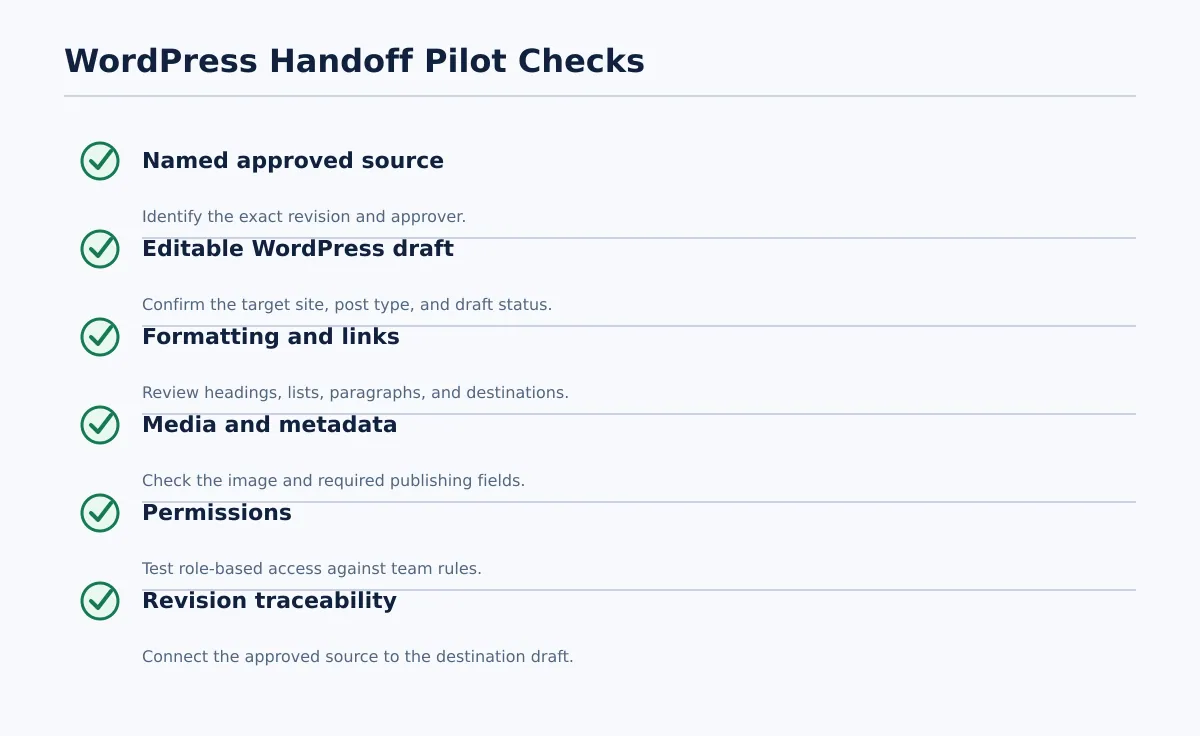 Use the same pilot checks for each shortlisted option.
A feature demonstration and a representative publishing run answer different questions. Test every shortlisted option with the same real-world sample so the team can compare outcomes rather than impressions.
Choose one article that includes:
- a title and multiple heading levels;
- a short list and a nested list;
- important internal and external links;
- one in-body image with an agreed placement or caption;
- an excerpt, slug, taxonomy, author, and other fields your sites require; and
- at least one post-review edit, so revision traceability can be checked.
Run the same test for every candidate
- Set up the test record. Name the source owner, document identifier, intended WordPress site, content type, approver, and QA owner. Identify the revision that will be considered for approval.
- Approve the identified revision. Ask the appropriate person to approve that revision. If it changes afterward, obtain a new approval or record an authorized exception.
- Create a WordPress draft. Use the candidate’s proposed handoff route. Confirm the target site, post type, and draft status before the content review starts. When the route produces HTML, use a process to check converted HTML before publishing rather than treating conversion as a release decision.
- Review editor and preview results. Inspect headings, paragraphs, lists, links, image placement, and required fields in the editable draft. Then inspect the preview, where spacing and media behavior can differ from the editing view.
- Test access and traceability. Confirm that the intended publisher can work on the draft, that a test user cannot act outside the team’s documented access rules, and that the team can connect the destination draft to the approved source revision.
- Record the result of each check. Use pass, fail, or needs-decision. Every failure needs an assigned owner and next action; “cleanup needed” is not enough to make a purchasing decision.
| Check | Pass condition | If it fails | Defect owner |
|---|---|---|---|
| Headings and body structure | The draft uses the agreed heading hierarchy and readable paragraphs. | Correct the transfer mapping or source structure, then rerun the affected check. | Publishing operator or source editor |
| Links | Important links retain the intended text and destination and open correctly from preview. | Restore the link from the approved source; route an unclear destination to the editor. | Publishing operator |
| Media | The expected image is present, placed correctly, and includes agreed supporting text where required. | Re-add or replace the asset, then repeat preview review. | Publishing operator or asset owner |
| Metadata | Required WordPress fields are complete and match the test record. | Map the field, add a documented manual step, or treat the gap as a failed must-have. | SEO or publishing lead |
| Permissions | Test roles behave according to the team’s documented access rules. | Revise configuration or pause the pilot until access behavior is understood. | System administrator |
| Revision traceability | The team can identify the approved source revision and its corresponding destination draft. | Investigate the missing connection; do not treat the test item as approved for release. | Content operations lead |
For a closer source-to-destination comparison, follow this approved document to published post QA workflow. Keep the resulting source revision, approval record, WordPress draft, preview result, and defect log together as pilot evidence.
Tenwrite may be relevant when the publishing need is to export Google Docs or Microsoft Word DOCX files in Google Drive to WordPress or Blogger. Its content index can also help users view and manage content across multiple sites. Test that publishing layer against the handoff requirements above; assess repository controls and approval governance separately when those are part of the project scope.
Make the decision and plan the rollout
Use the matrix, weighted score, and pilot record together. A pilot that changes your shortlist or exposes a narrower problem has done useful work: it has prevented the team from making a broad purchase decision on incomplete evidence.
Choose one of three paths.
- Proceed with a bounded rollout. Continue when all must-have acceptance tests pass, any manual steps are accepted by the responsible owners, and the initial operating process is documented. Begin with one content type, one site or client group, and a small set of active articles.
- Retest after a defined correction. Choose this path when the candidate is otherwise suitable but a specific defect can be corrected, such as a missing metadata mapping or unclear review role. Make the change, rerun the same sample, and retain both test records.
- Narrow the project. If document controls already pass but the WordPress pilot does not, the immediate need may be a better transfer route, a documented preparation step, or stronger final QA—not a replacement enterprise platform.
Assign one process owner for the first rollout. That person does not need to do every task, but should maintain the matrix, collect test evidence, decide how exceptions are handled, and ensure training matches the workflow that was actually tested. Keep the initial content set small enough that the team can identify the active source, correct defects, and adjust roles without disrupting a larger migration.
Before committing to a platform, run one real document through one real approval path and into a WordPress draft. The pass/fail record will show whether you need enterprise content management software, a publishing-handoff improvement, or a coordinated combination of both.