
WordPress - Document Frontmatter
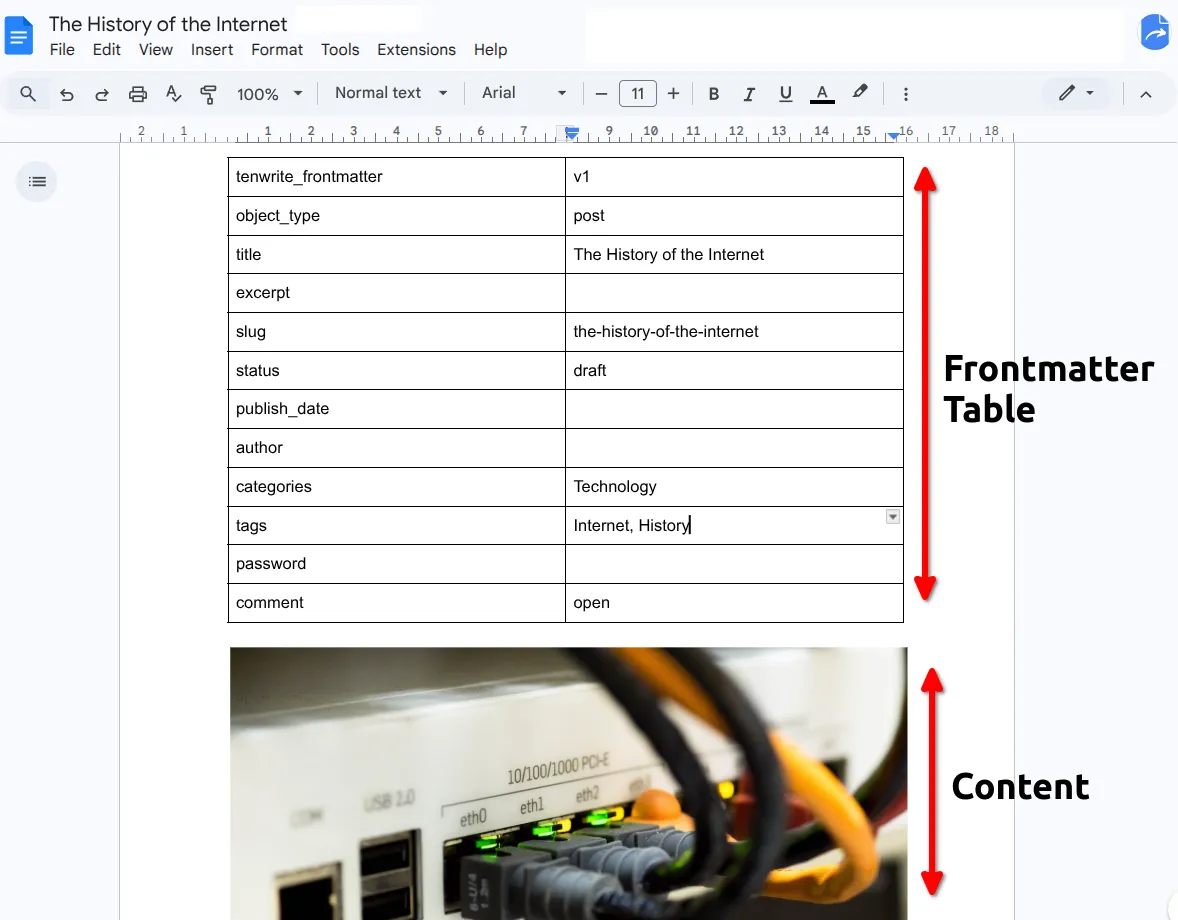
Frontmatter keeps your WordPress post settings in a small table at the top of your Google Doc. Use Tenwrite’s editor to set titles, categories, tags, and publication dates, or edit the table directly if you prefer.
This is especially useful with Drive Automation and Sheet Automation, where there’s no export form at all. Frontmatter is how you control individual posts when publishing is fully automated. It also works with manual exports.
Prefer a video? Watch where to set WordPress export settings for a quick comparison of the export form, your document’s frontmatter table, and Google Sheets.
Open the Editor
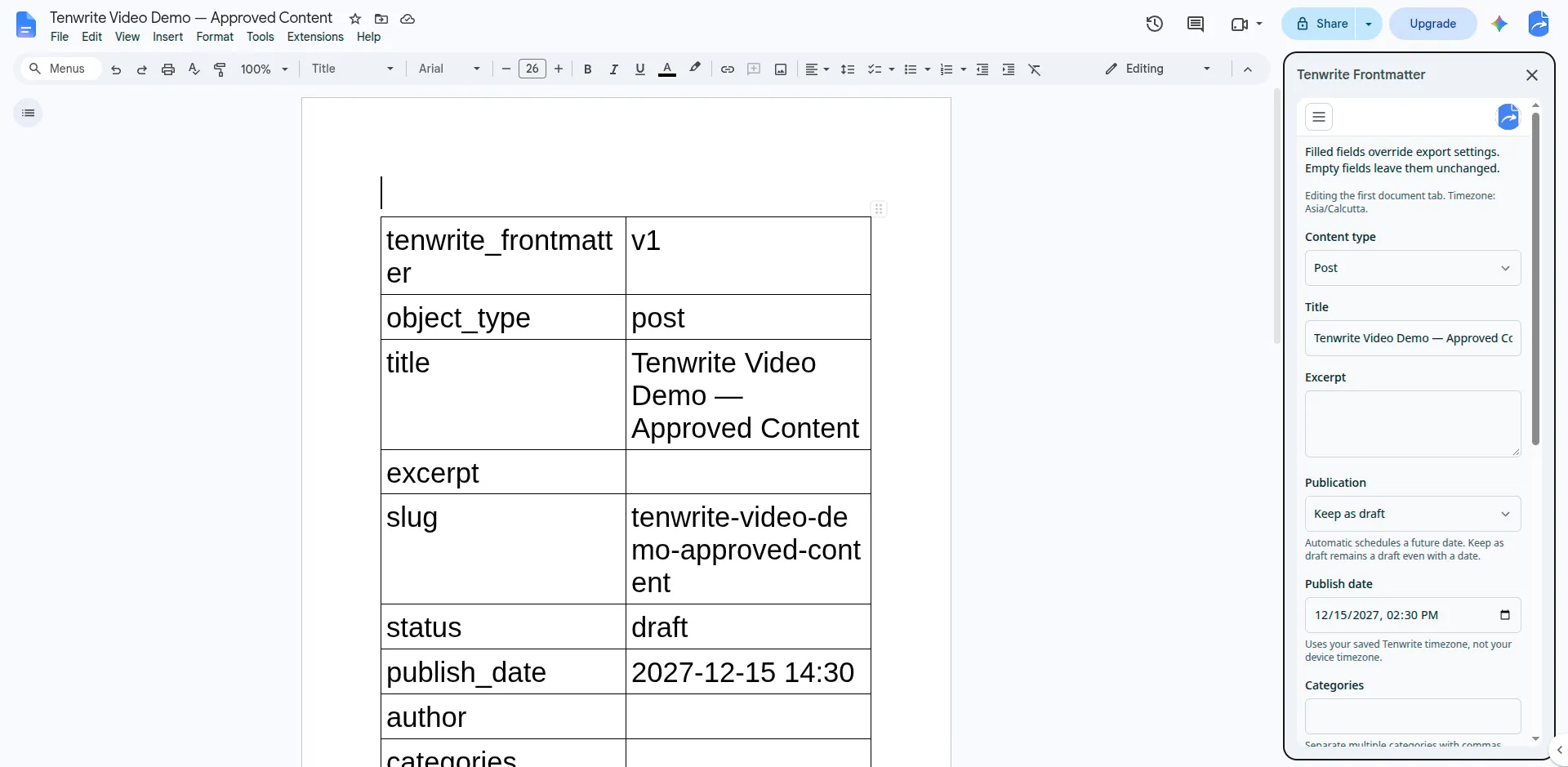
Section titled “Open the Editor”Open your Google Doc and choose Extensions > Tenwrite > Frontmatter > Insert WordPress Frontmatter. Tenwrite opens the editor in the sidebar. It creates a starter table if one is missing, or opens your existing table without replacing it.
In the web dashboard, select your document on WordPress > New Export. If frontmatter is already present, click Edit existing frontmatter. Filled fields—including categories, tags, SEO settings, and an explicit publication status—are read-only in the export form and marked Already set in frontmatter. Change or remove the value in frontmatter; clearing it lets the form control that setting again. Without frontmatter, use the export form; Tenwrite will not ask you to add a table. Shared formatting controls stay available for the batch, while each document’s overrides are shown under Other settings from this document. You can also open the editor from the Sync confirmation.
When the export form shows Checking publication outcome…, wait for the check to finish before editing the document’s export fields. This also applies when you refresh document settings. Tenwrite then locks fields filled in frontmatter and leaves the other fields editable. If the check fails, fix the problem and choose Check again.
Fill in the settings you need. Open Advanced fields for options such as author, slug, comments, and SEO fields. Click Save frontmatter to save to the Google Doc, then check the outcome preview.
Filled frontmatter values override the matching export settings. Empty fields leave the export settings or existing WordPress values unchanged; they do not clear values on your site. Custom rows stay in place and appear read-only in the editor.
When Tenwrite processes the document, it reads the table, applies the values to the post, and removes the table from the published content. Your readers never see it.
SEO Frontmatter
Section titled “SEO Frontmatter”If your self-hosted WordPress site has the Tenwrite plugin installed, the same frontmatter table can also control supported SEO fields.
Add any of these rows when you want the Google Doc to control SEO during export or sync:
| Field | Description | Example |
|---|---|---|
seo_title | SEO title | Complete Guide to Automation |
seo_description | Meta description | Learn the fastest way to automate. |
focus_keyword | Focus keyword | wordpress automation |
canonical_url | Canonical URL | https://example.com/automation |
no_index | Tell search engines not to index | false |
no_follow | Tell search engines not to follow links | false |
If one of these SEO fields is present in frontmatter, Tenwrite treats that field as controlled by the Google Doc during export and sync.
That means:
- the matching field is locked in Tenwrite
- you update or remove it in the Google Doc instead
- after changing the document, run Sync Post to push the update to WordPress
For text SEO fields, an empty value means Tenwrite treats that field as not set, so you can still edit it in the app.
For no_index and no_follow, an explicit true or false value counts as set.
Available Fields
Section titled “Available Fields”| Field | Description | Example |
|---|---|---|
tenwrite_frontmatter | Required marker — don’t change this | v1 |
object_type | Post or page | post |
title | Post/page title | Complete Guide to Automation |
excerpt | Short summary for archive pages | Quick summary for archive pages |
slug | URL slug | complete-guide-to-automation |
status | Publish state | future |
publish_date | Schedule date and time | 2027-12-15 09:30 |
author | Author username, email, or ID | editor@example.com |
password | Post password | my-secret |
categories | Comma-separated category names | WordPress, Automation |
tags | Comma-separated tag names | google docs, tenwrite |
comment | Comment status | open |
ping | Ping status | open |
format | Post format | standard |
sticky | Sticky post | false |
template | Page template path | templates/landing.php |
parent | Parent page ID (for pages) | 42 |
menu_order | Page order in menus | 1 |
featured_media | URL of existing media to use as featured image | https://example.com/image.jpg |
preset | Formatting preset to apply | balanced |
Status
Section titled “Status”Choose Publication in the editor, or use these values when editing the table directly:
| Table value | What happens |
|---|---|
| Blank / Automatic | Uses the export choice without a date; schedules with a valid future date |
draft | Keeps a draft, even with a future date |
publish | Publishes now without a future date; schedules with a valid future date |
future | Schedules for a valid future publish_date |
pending | Keeps the post pending review, even with a future date |
private | Keeps the post private, even with a future date |
To schedule a post, enter a future Publish date. The editor selects Scheduled unless you chose Keep as draft. Save, then check the scheduled time in the preview. The table stores status: future and the date together.
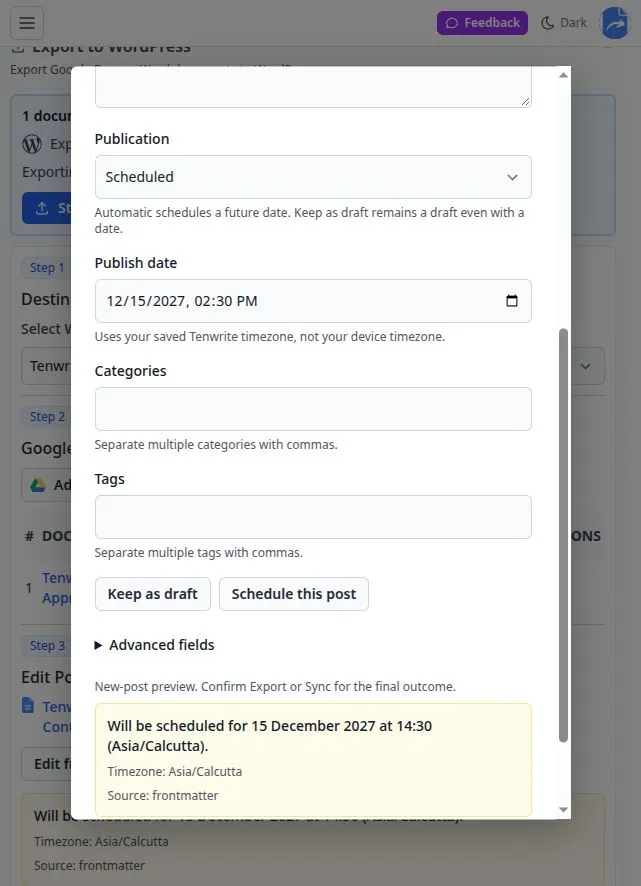
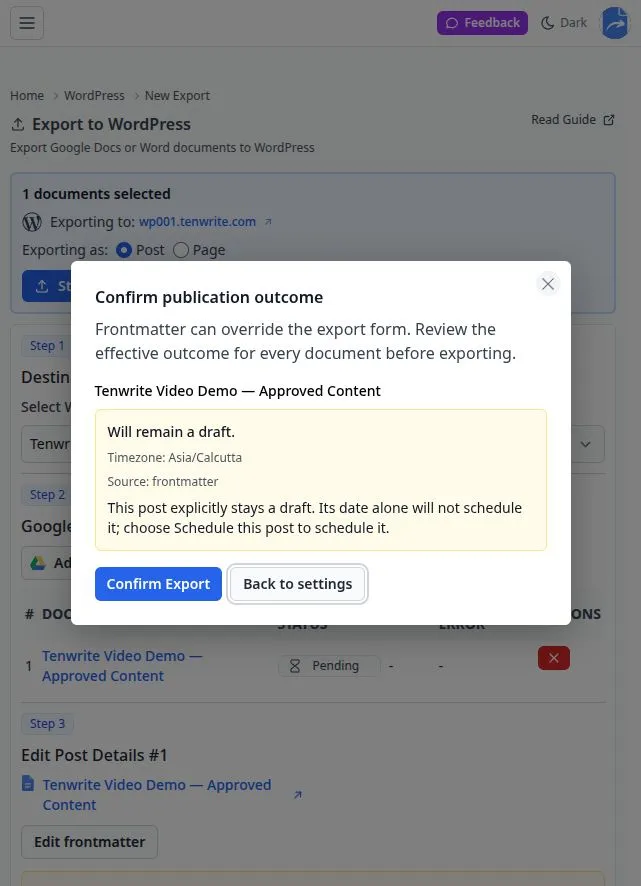
To keep working without publishing, choose Keep as draft in Publication and save. A date does not override an explicit draft choice. Opening an older document with draft and a date does not change it; choose Scheduled in Publication and save when you want to schedule it instead.
Use YYYY-MM-DD HH:MM when editing a date in the table, for example 2027-12-15 09:30.
Check Before Export or Sync
Section titled “Check Before Export or Sync”Before starting an export, Confirm publication outcome shows what Tenwrite will actually do for every document. Automatic plus a future date schedules the post even if the export form still says Draft. Review the result before clicking Confirm Export.
Sync also asks you to confirm the outcome. If publication settings are blank, Sync preserves the existing post’s state. Updating a title alone does not turn a published post into a draft. To cancel a schedule, choose Keep as draft, save, and confirm Sync.
An unchanged schedule that has already published is preserved when WordPress’s publication date matches the document. If Tenwrite reports a mismatch, correct the settings before syncing.
Optional Formatting Fields
Section titled “Optional Formatting Fields”You can also add these fields to control how Tenwrite transforms the document’s HTML during export:
remove_inline_styles—true/falseremove_font_family—true/falseremove_font_size—true/falseremove_color—true/falseremove_text_decoration—true/falseremove_background—true/falseremove_padding—true/falseremove_margin—true/falseremove_width—true/falseremove_height—true/falseremove_line_height—true/falseremove_border—true/falseremove_letter_spacing—true/falseremove_text_transform—true/falseremove_max_width—true/falseremove_max_height—true/falsedemote_headings—true/falseadd_rel_nofollow_to_links—true/falseadd_target_blank_to_links—true/falseincrease_line_height—true/falseconvert_pt_to_px—true/falsestrip_empty_elements—true/falseresponsive_images—true/falseembed_youtube—true/falseembed_twitter—true/falseupload_images_to_media_library—true/falseuse_first_image_as_featured_image—true/false
Example Table
Section titled “Example Table”| Key | Value |
|---|---|
tenwrite_frontmatter | v1 |
object_type | post |
title | Complete Guide to WordPress Automation |
excerpt | Learn how to automate your WordPress publishing workflow using Google Docs. |
status | future |
publish_date | 2026-12-31 09:00 |
slug | wordpress-automation-guide |
categories | WordPress, Automation, Tutorials |
tags | wordpress, automation, google docs |
comment | open |
ping | open |
preset | balanced |
Troubleshooting
Section titled “Troubleshooting”Frontmatter isn’t being applied
Section titled “Frontmatter isn’t being applied”- The table must be the very first element in the document — nothing before it.
- Use Extensions > Tenwrite > Frontmatter to insert a correctly formatted table.
- Don’t edit the first row (
tenwrite_frontmatter:v1) — only change values in the second column. - If Tenwrite reports duplicate fields, multiple markers, or an unsupported table structure, repair the existing table in Google Docs rather than inserting another one.
Someone else edited the document while I was saving
Section titled “Someone else edited the document while I was saving”Tenwrite keeps your unsaved fields and does not overwrite the newer document. Copy any changes you want to keep before choosing Reload current document, which discards your unsaved fields. Reopen the editor and apply your changes to the current version.
Scheduled post isn’t publishing at the right time
Section titled “Scheduled post isn’t publishing at the right time”- Check that Publication is Scheduled, not Keep as draft. In the table, use
status: futurewith a valid futurepublish_dateinYYYY-MM-DD HH:MMformat. - Check the timezone shown in the preview; scheduling uses your saved Tenwrite timezone.
- If the date passed while an export was waiting, correct it and review the outcome again. Tenwrite will not silently publish a missed schedule.
Categories or tags aren’t applying
Section titled “Categories or tags aren’t applying”- Use comma-separated format:
category1, category2. - Double-check the field names:
categoriesandtags(notcategoryortag).
Comment or ping settings aren’t working
Section titled “Comment or ping settings aren’t working”- Use
commentandpingin frontmatter, notcomment_statusorping_status.
Related Guides
Section titled “Related Guides”- Export Google Docs to WordPress
- WordPress Plugin
- Use SEO Fields with the Tenwrite Plugin
- Sync Post
- WordPress - Drive Automation
- WordPress - Sheet Automation
For help with frontmatter setup, contact support@tenwrite.com.
Tenwrite is an independent product not affiliated with or endorsed by Google LLC, Blogger, or WordPress Foundation. Google Docs, Gmail, Google Workspace are trademarks of Google LLC. WordPress is a trademark of the WordPress Foundation.