
Export Google Docs to WordPress
Tenwrite lets you publish Google Docs directly to WordPress — one at a time or in a batch. You pick the destination site, add your documents, set any post details you need, and hit Start Export. Tenwrite handles the conversion and publishing.
Before You Start
Section titled “Before You Start”Make sure you have:
- At least one WordPress site connected to Tenwrite (see How to Connect Your WordPress Site)
- One or more Google Docs ready to publish
Watch: Where to Set Export Settings
Section titled “Watch: Where to Set Export Settings”Prefer a quick walkthrough? This 42-second video shows three places to control your WordPress export settings: the manual export form, a frontmatter table in your Google Doc, and Google Sheets automation.
Open the WordPress export settings video walkthrough, or watch it on YouTube.
Follow the steps below for a manual export, or see the guides for WordPress frontmatter and Sheet Automation if you set your options in a document or spreadsheet.
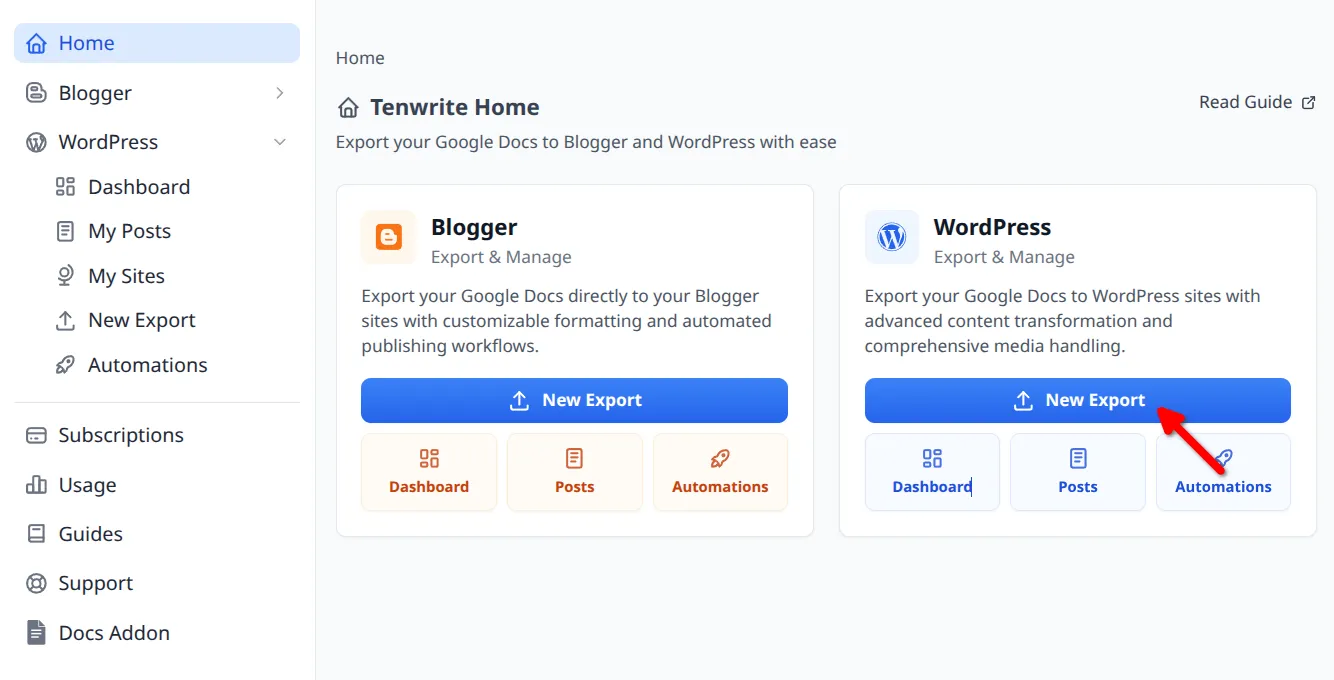
Open the Export Page
Section titled “Open the Export Page”Open the Tenwrite add-on or the Web Dashboard, then click WordPress > New Export.
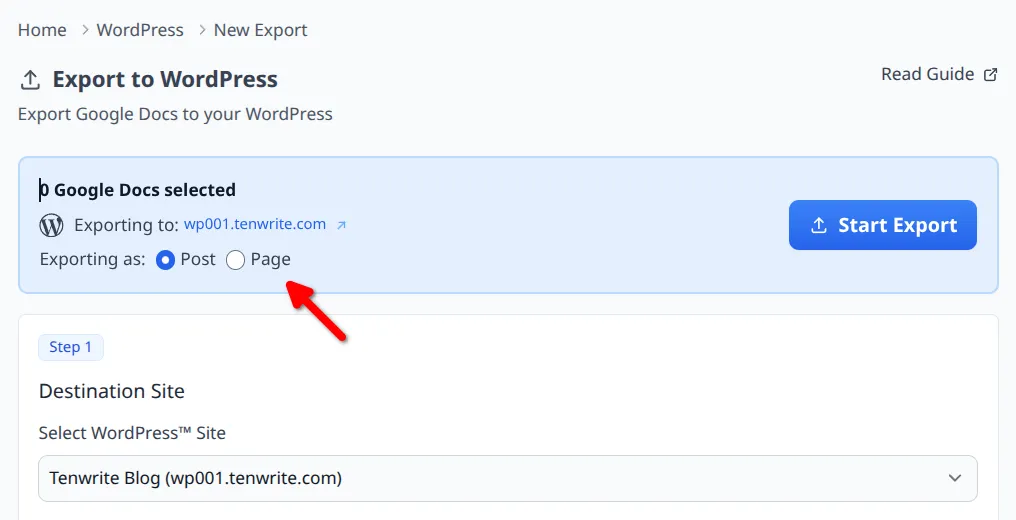
Choose: Post or Page
Section titled “Choose: Post or Page”At the top of the export form, choose whether WordPress should create a Post (standard blog content) or a Page (static standalone content). You can change this at any point before starting the export.
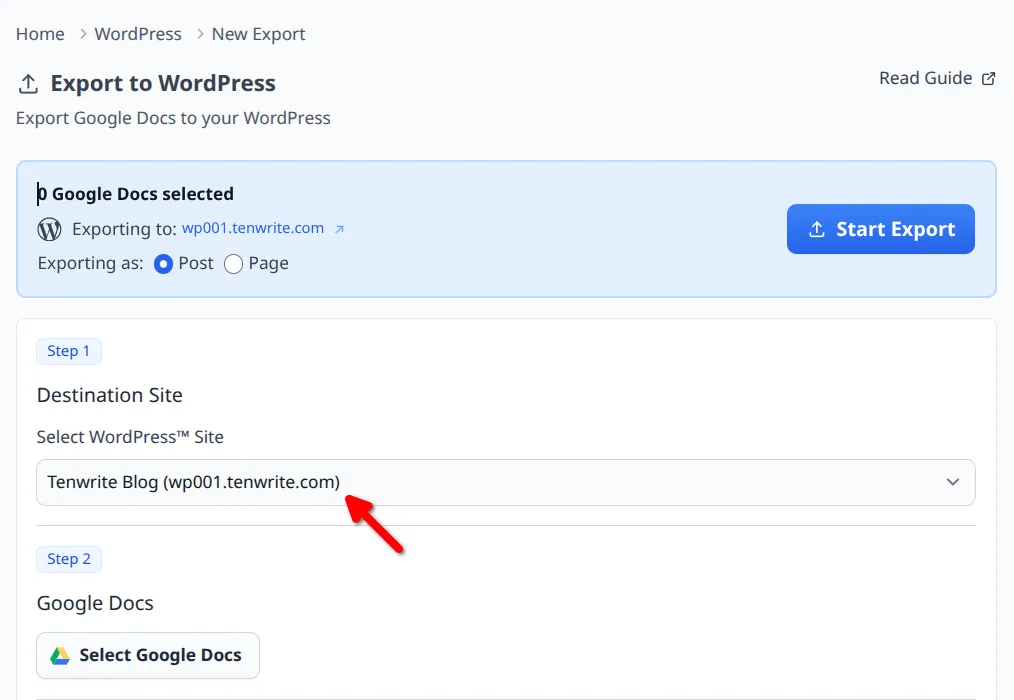
Step 1 — Choose Your Destination Site
Section titled “Step 1 — Choose Your Destination Site”Select the WordPress site you want to publish to. This applies to all documents in the batch.
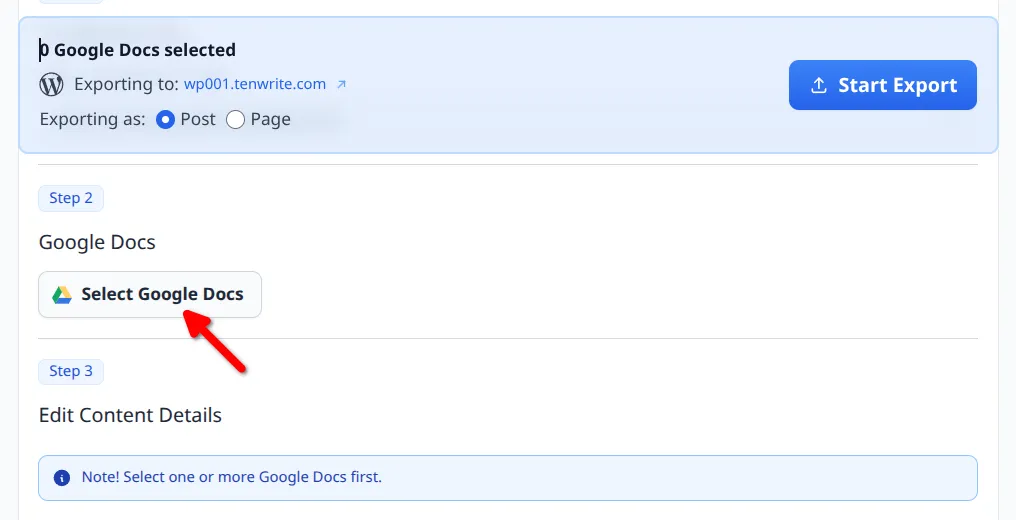
Step 2 — Add Your Google Docs
Section titled “Step 2 — Add Your Google Docs”Click Select Google Docs, pick one or more files from the Google Drive picker, then click Select to add them to the export list.
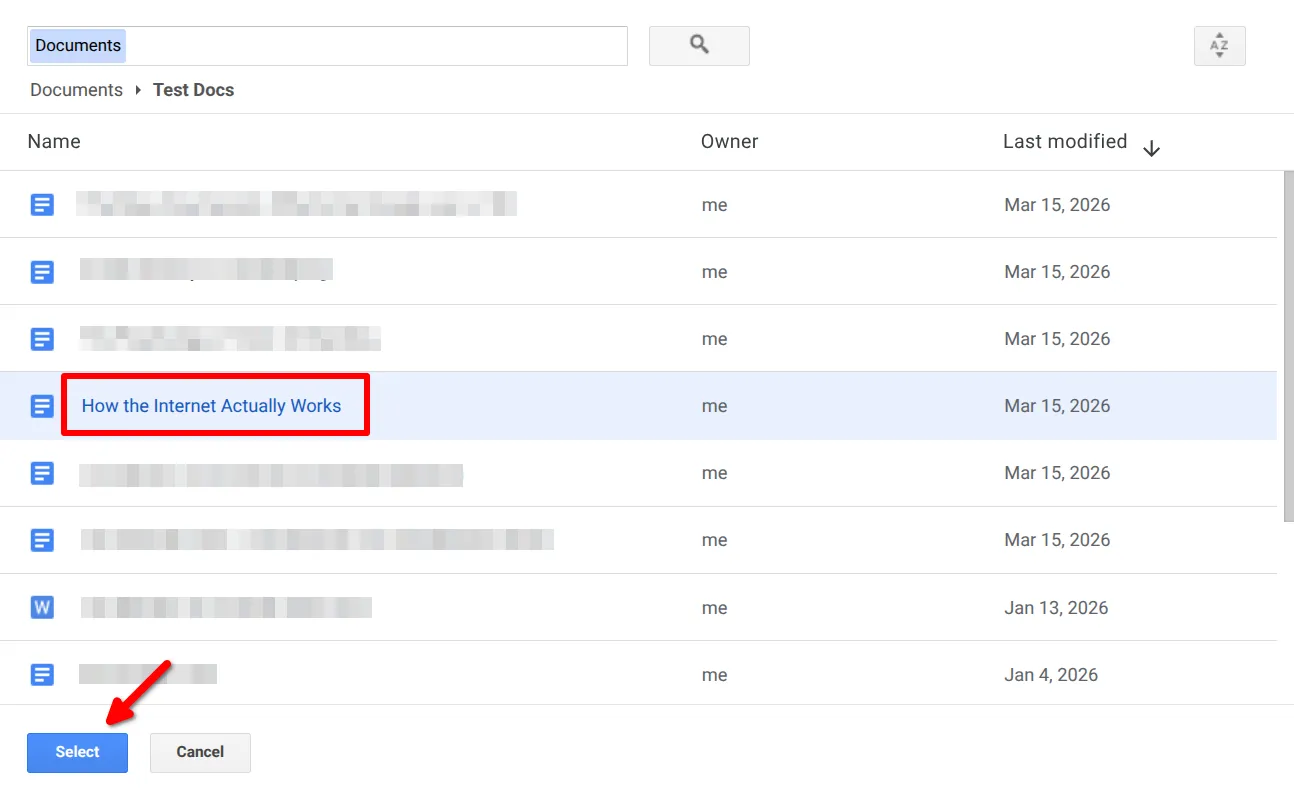
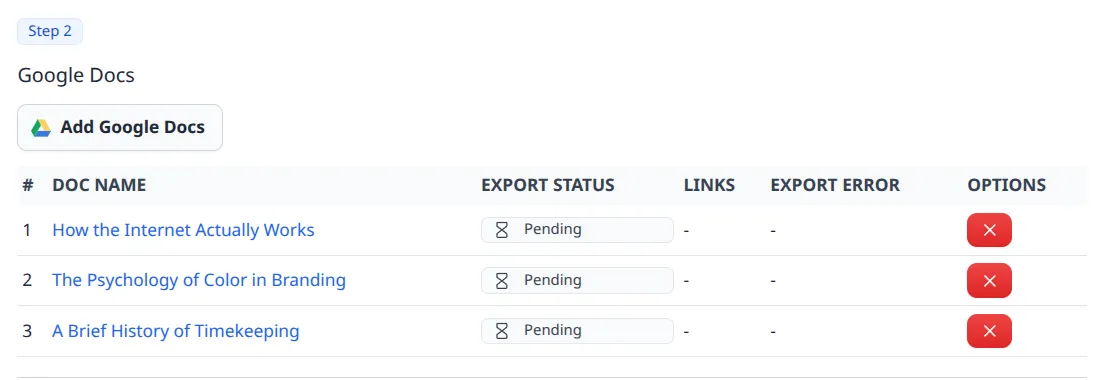
Once added, your documents appear in a table below the picker. You can:
- Click Add Google Docs to include more files.
- Click the remove button next to any file you don’t want to export.
Step 3 — Set Post Details
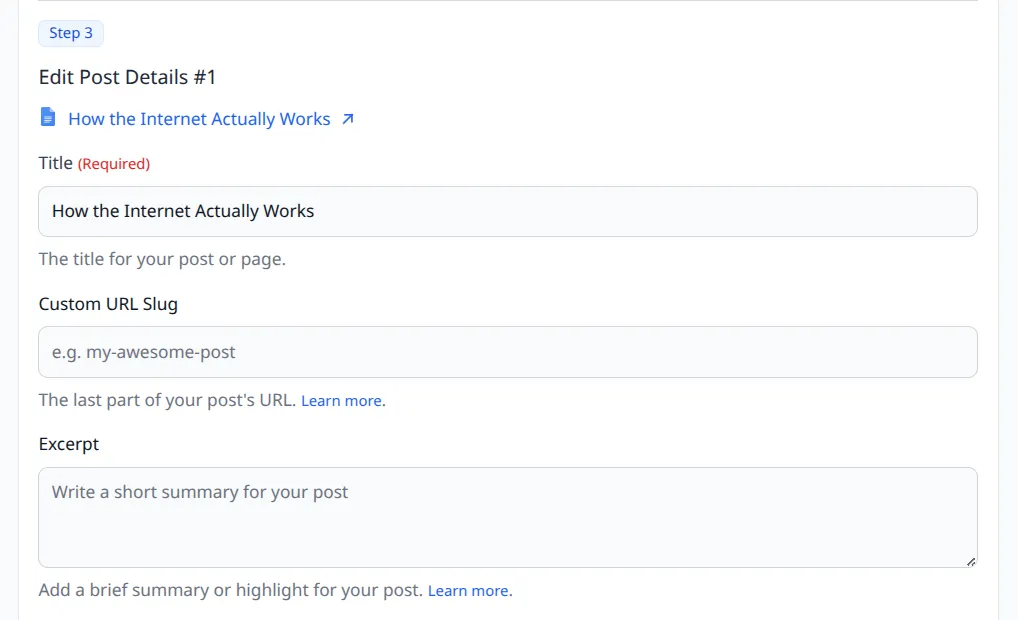
Section titled “Step 3 — Set Post Details”Tenwrite shows per-document settings for each file you’ve added. If you exported multiple documents, use Prev and Next to move through them.
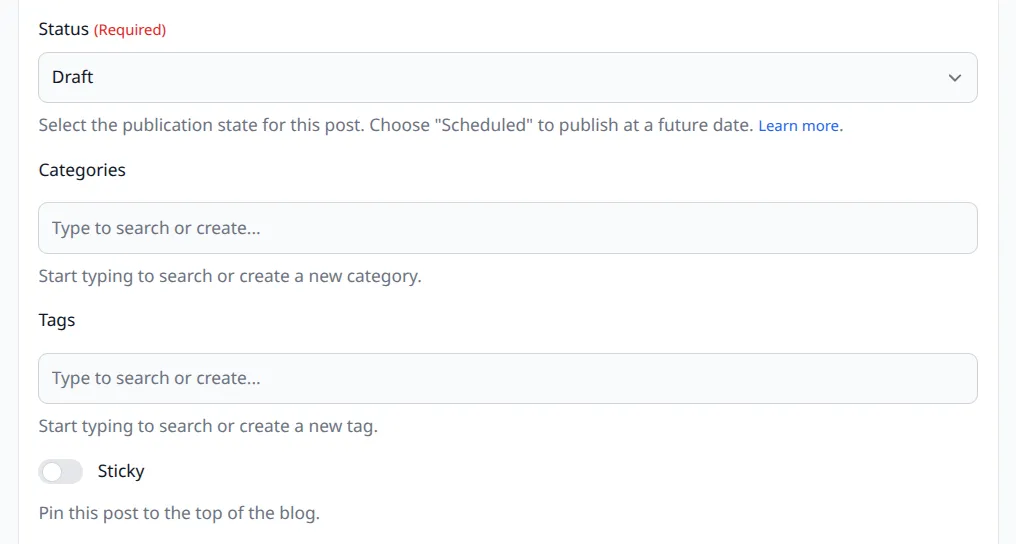
For every document, you can set:
- Title (required)
- Custom URL Slug
- Excerpt
- Status —
Draft,Publish,Pending,Private, orScheduled - Publish Date (only when Status is
Scheduled) - Discussion — open or close comments
- Pingbacks & trackbacks
For Posts, you can also set categories, tags, and sticky.
For Pages, you can also set parent page and menu order.
If the document already contains frontmatter, Tenwrite shows a notice and Edit existing frontmatter. Filled fields—including categories, tags, and an explicit status—are read-only in the export form and marked Already set in frontmatter. Edit or remove the value in frontmatter to change it; empty fields use the form values. Without frontmatter, use the form normally; no table is needed or inserted. If Tenwrite cannot read or validate frontmatter, correct the problem before exporting. See WordPress frontmatter for scheduling and keeping dated posts as drafts.
If your self-hosted WordPress site has the Tenwrite plugin installed, Step 3 can also include SEO controls for:
- SEO title
- meta description
- focus keyword
- canonical URL
- noindex
- nofollow
If the selected Google Doc already sets any of those values in WordPress frontmatter, Tenwrite treats those matching SEO fields as controlled by the document.
That means:
- those fields appear locked in the export form
- you update or remove them in the Google Doc instead
- frontmatter wins for those matching fields during export
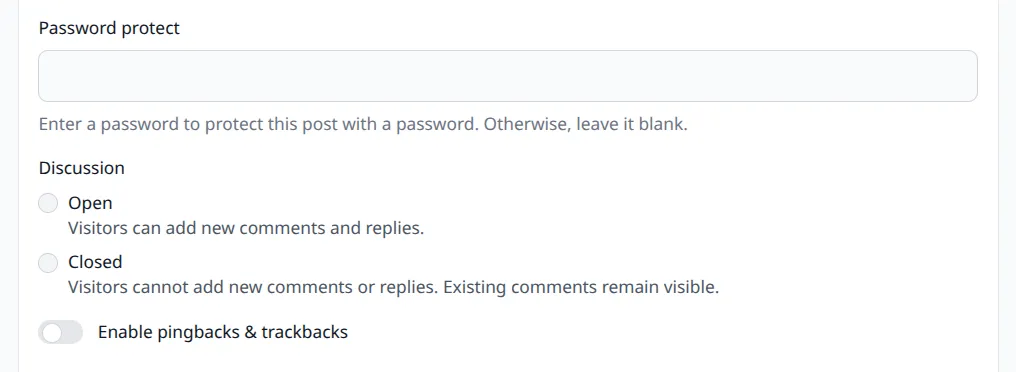
Step 4 — Advanced Options (Optional)
Section titled “Step 4 — Advanced Options (Optional)”If you want more control over how the content is converted, click Show Advanced Options to reveal Step 4: Content Formatting & Optimization.
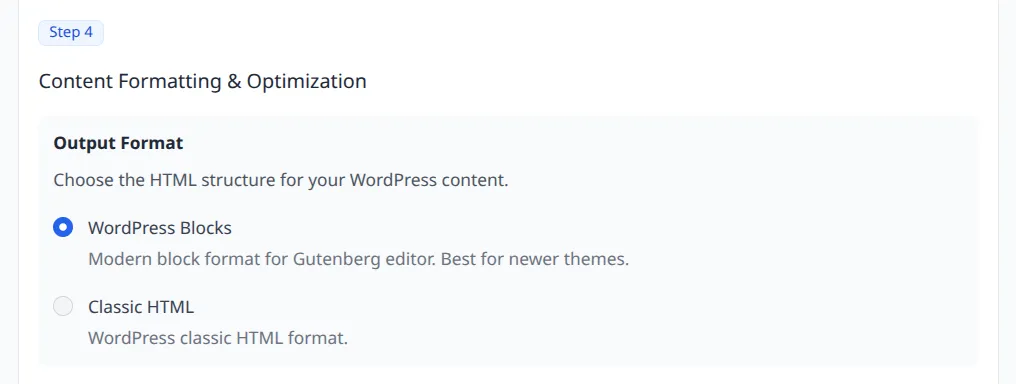
Output Format
Section titled “Output Format”Choose how Tenwrite structures the content in WordPress:
- WordPress Blocks — exports in Gutenberg block format. Best for modern block themes and sites actively using the block editor.
- Classic HTML — exports as standard HTML. Use this for classic-editor workflows, older themes, or legacy setups.
Not sure? Start with WordPress Blocks — it works well for most modern WordPress sites.
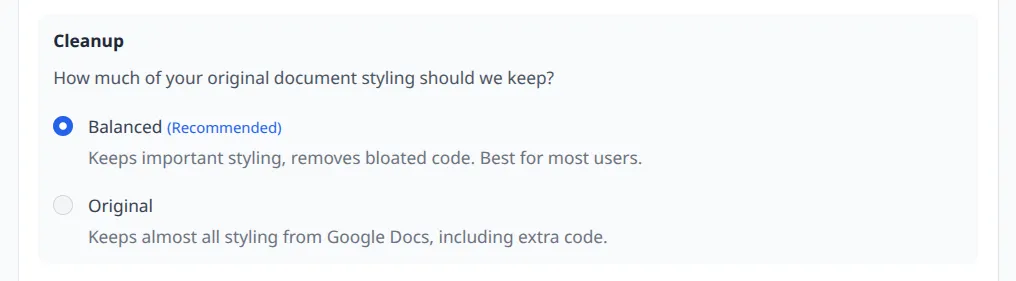
Cleanup
Section titled “Cleanup”Controls how much of Google Docs’ original styling comes through:
- Balanced — strips unnecessary markup while preserving important formatting. This is the recommended default.
- Original — keeps more of the original styling if you need it.
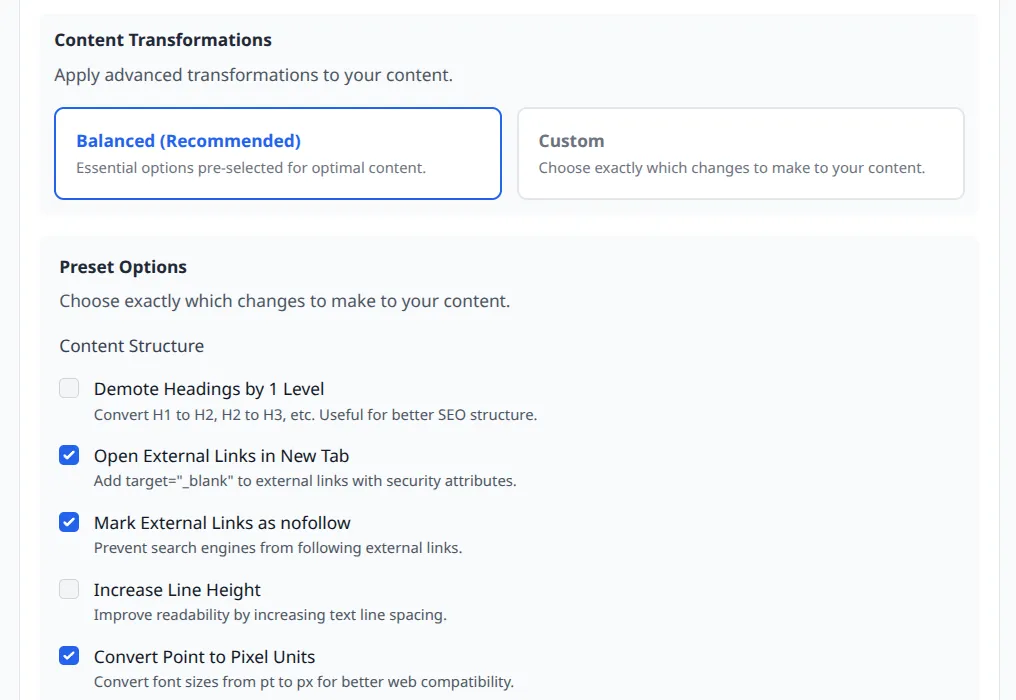
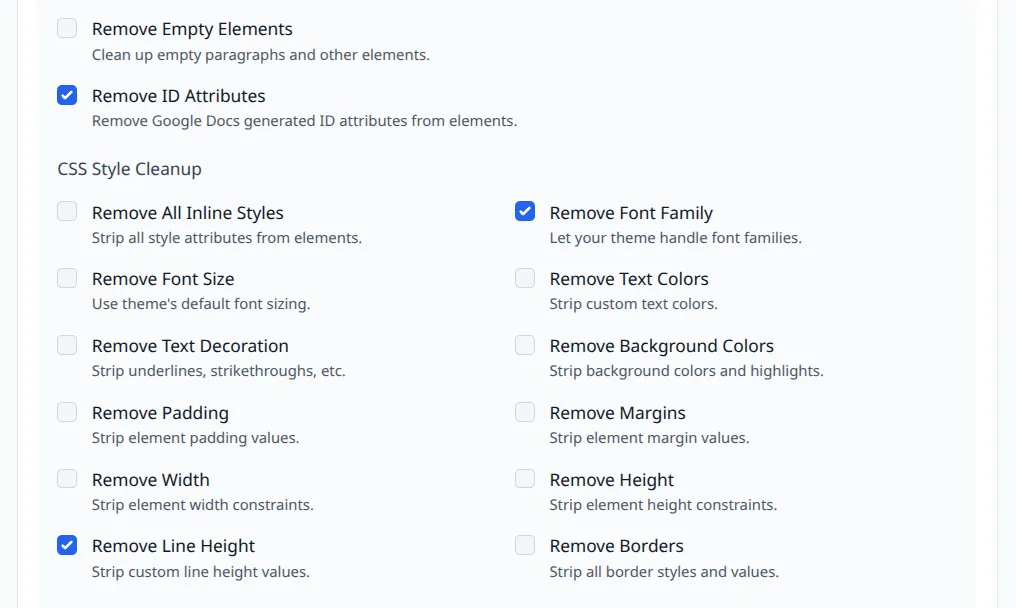
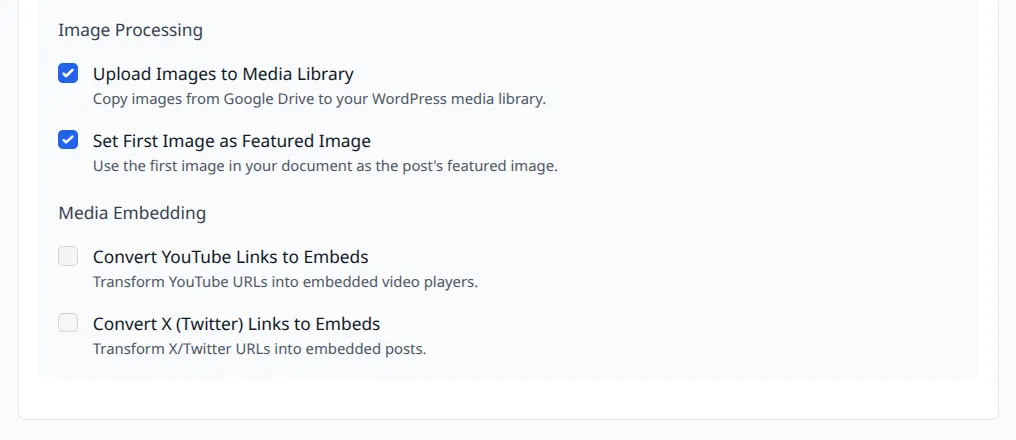
Content Transformations
Section titled “Content Transformations”- Balanced (Recommended) — applies a sensible, pre-selected set of transformations. Start here.
- Custom — gives you full control over individual transformation settings.
When you switch to Custom, Tenwrite auto-saves your preferences as a preset.
Start the Export
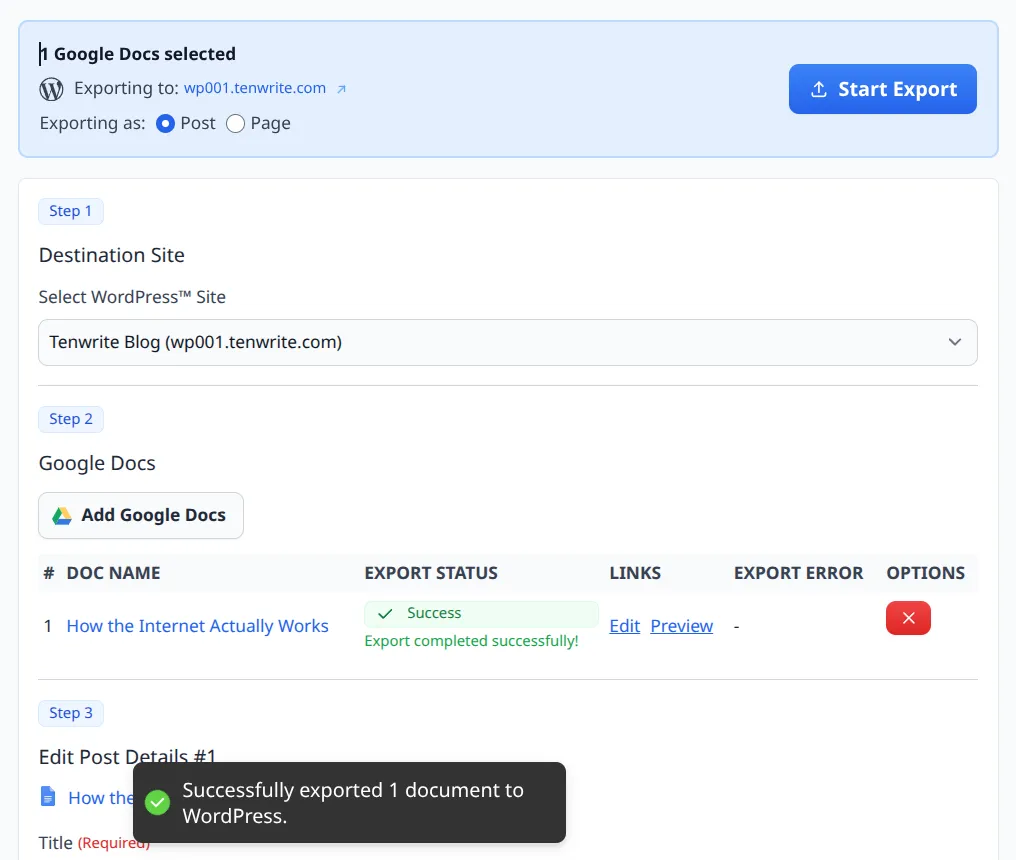
Section titled “Start the Export”Before you click Start Export, check that the header shows the right number of documents, the correct destination site, and the right export type (Post or Page).
Clicking Start Export opens Confirm publication outcome; it does not start publishing yet. Review the actual status, date, and timezone for each document, then click Confirm Export. Choose Back to settings if you need to change anything.
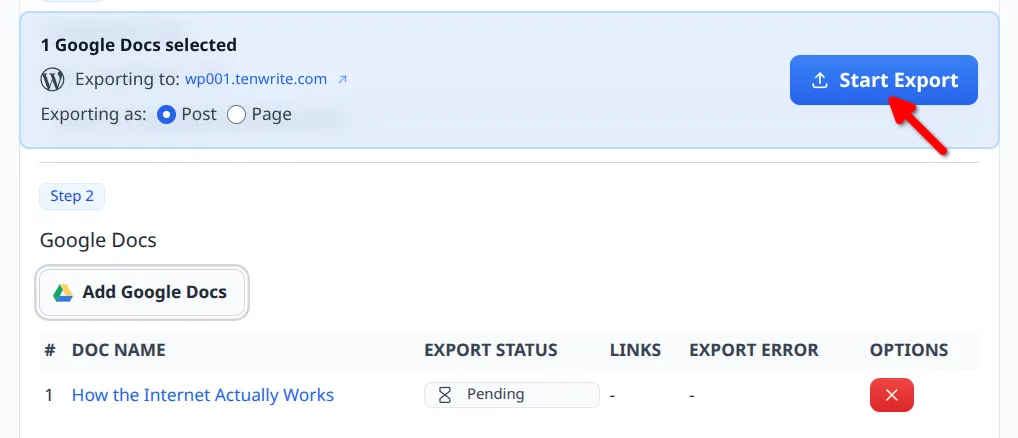
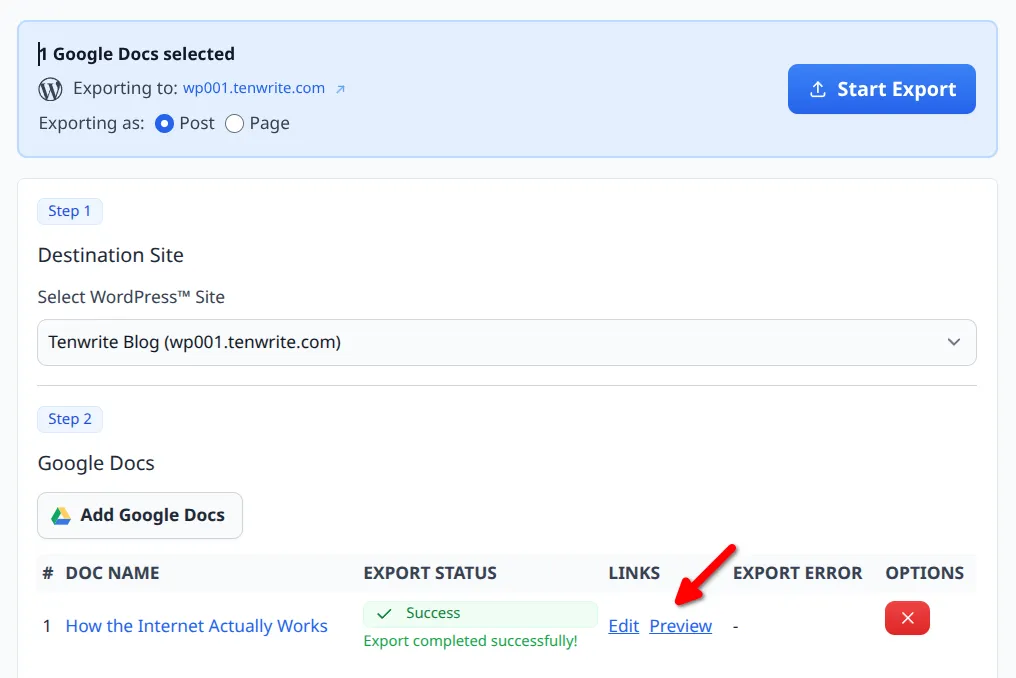
Each row tracks its own status — Pending, Processing, Success, or Error — so you can follow progress in real time.
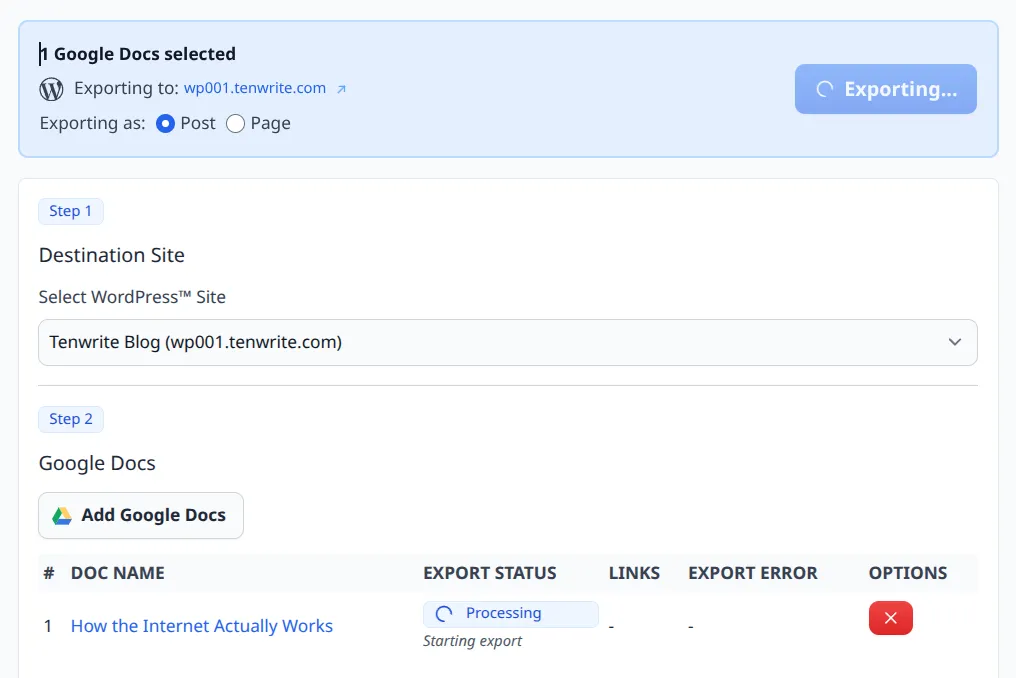
When a document finishes successfully, Tenwrite shows a toast notification and adds Edit and Preview links to that row.
Troubleshooting
Section titled “Troubleshooting”No WordPress sites appear in the destination dropdown
Section titled “No WordPress sites appear in the destination dropdown”Go to WordPress > My Sites and confirm your sites are connected. If you haven’t connected a site yet, follow How to Connect Your WordPress Site to Tenwrite.
The site list looks outdated
Section titled “The site list looks outdated”Go to WordPress > My Sites and click Sync Site Content to refresh, then return to the export page.
Authentication or permission error
Section titled “Authentication or permission error”Refresh the page and try again. If the issue persists, sign out and back in. Make sure your connected WordPress user has publish permissions on the destination site.
A file I selected isn’t a Google Doc
Section titled “A file I selected isn’t a Google Doc”Google Docs and Word .docx files are supported. For a different format, convert it to Google Docs before selecting it. Direct frontmatter editing requires a native Google Doc.
Some documents failed
Section titled “Some documents failed”Check the error message shown in the row. Common causes are temporary network issues, WordPress permission problems, or invalid post settings. Try exporting failed items as a smaller batch.
A scheduled post didn’t publish
Section titled “A scheduled post didn’t publish”Make sure Status is set to Scheduled and the Publish Date is set to a time in the future (in your timezone). Check WordPress after the scheduled time has passed.
Related Guides
Section titled “Related Guides”- How to Connect Your WordPress Site to Tenwrite
- WordPress - Manage Sites
- WordPress - Manage Posts
- WordPress - Document Frontmatter
- WordPress Plugin
- Use SEO Fields with the Tenwrite Plugin
If you’re still stuck, email support@tenwrite.com with the steps you took, the error message, and your WordPress site URL.
Tenwrite is an independent product not affiliated with or endorsed by Google LLC, Blogger, or WordPress Foundation. Google Docs, Gmail, Google Workspace are trademarks of Google LLC. WordPress is a trademark of the WordPress Foundation.